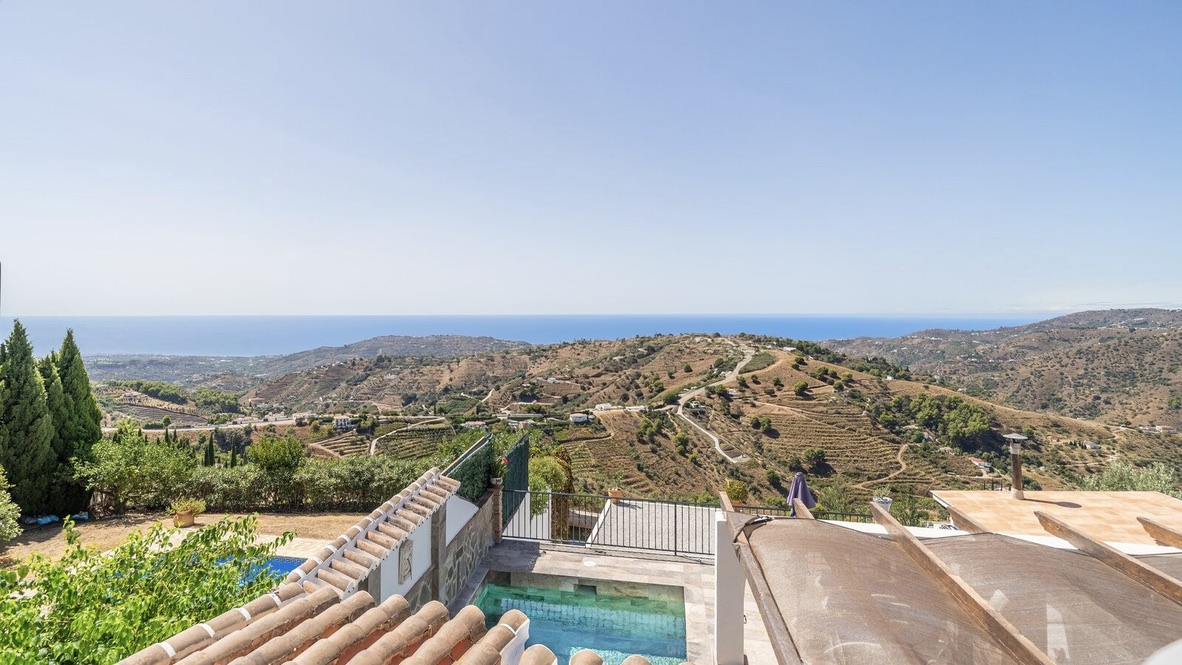
Frigiliana has no beach. It sits about 6 km inland, on the slopes of the Sierra Almijara, and that is exactly what makes it so pleasant in summer: you sleep in the countryside, cooler than down on the coast, and you’re at the sea in a quarter of an hour.
The beaches you’ll actually use are in Nerja and the coves of Maro. From our house, on the hillside above the village, Nerja is about 25 minutes by car and Maro about ten minutes more. Here’s which ones are worth it, and what kind of day each one suits.
Burriana, Nerja’s big beach
Burriana is Nerja’s main beach and the easiest for a full day. It’s long, sand and shingle, with a promenade, beach bars, sunbed hire, water sports and parking nearby. Its restaurants are known for paella cooked over wood fires right on the sand.
It isn’t the prettiest beach in the area, but it is the most comfortable. With children, older relatives or anyone who just wants an easy day, it’s the safe choice. In August it fills up, so get there before eleven for a good spot.
Calahonda and Carabeo, the coves in town
Below the Balcón de Europa, Nerja’s famous viewpoint, is Calahonda: a small cove between rocks, with fishing boats and very clear water. You reach it down a staircase from the Balcón itself.
A few minutes’ walk east is Carabeo, another cove of about 120 metres with views of the cliffs. Both are small and fill quickly in summer. They work better for an early swim followed by coffee in the centre of Nerja than for a whole day.
La Torrecilla, the most accessible
On the west side of Nerja is La Torrecilla, a town beach with the seafront promenade right behind it. It’s flat, with ramps, boardwalks and, in summer, amphibious wheelchairs for getting into the water.
If anyone in your group struggles walking on sand or with stairs, this is the beach. It’s also easy with a pushchair.
Maro and El Cañuelo, the scenery
East of Nerja begins the Acantilados de Maro-Cerro Gordo Natural Site, a protected stretch of coast that runs to Almuñécar, in Granada province. This is where the most beautiful coves in the area are: clear water, cliffs and almost no buildings.
Maro beach lies below the village of the same name. You park at the top and walk down a steep slope for 15 to 20 minutes. In high season there’s usually a shuttle minibus. It’s excellent for kayaking or paddleboarding along the cliffs, and for snorkelling.
El Cañuelo is a little further east. It’s a pebble cove, not sand, about 350 metres long, with pine woods running almost down to the water. In summer you can’t drive down in a private car: you take the minibus from the parking area or walk.
Two tips for both: bring water shoes, because the seabed is stony, and arrive early. In August the car parks at the top are full by mid-morning.
Which to pick for your day
- A long, easy day with lunch on the beach: Burriana.
- A quick swim and a stroll round Nerja: Calahonda or Carabeo.
- Limited mobility or a pushchair: La Torrecilla.
- The best scenery and clearest water: Maro or El Cañuelo, with proper shoes and an early start.
When to go to the beach from Frigiliana
From June to September the water is warm enough to swim. In July and August the coast is busy and the midday heat is strong, so the local rhythm is beach in the morning, back for lunch or a siesta, and the afternoon by the pool. In May and October the sea is cooler, but you’ll have the coves of Maro almost to yourself.
My advice: go to the beach in the morning and keep the evening for the village. Frigiliana’s old town is at its best at sunset, once the coach trips have left. If you’re staying longer, drive up to El Acebuchal too, seven minutes from the house.
If you’re looking for somewhere to stay between the mountains and the sea, El Olivo is a country house for four with a private saltwater pool and Mediterranean views. You can see what the house is like and all its photos.