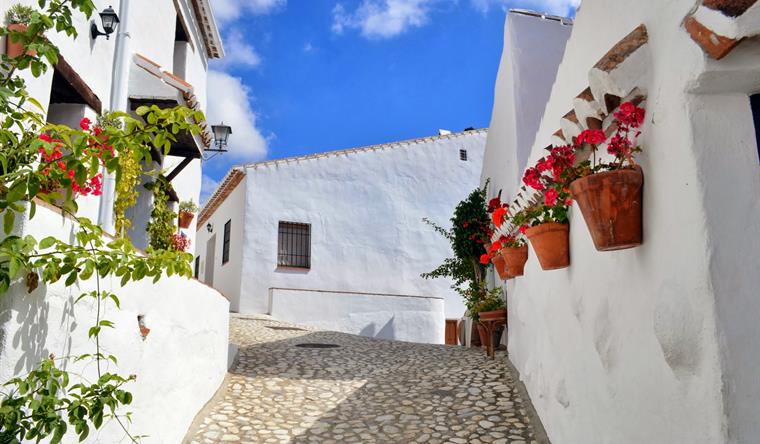
Some Andalusian villages have made their name through renovation and tourism. El Acebuchal, a hamlet in the municipality of Frigiliana in the heart of the Axarquía, made it the opposite way: it disappeared for half a century and came back to life when nobody expected it to. Today it’s one of the most singular corners of Málaga province, and if you’re staying in Frigiliana it’s the kind of place you shouldn’t miss.
This guide covers what you need to know to visit it properly: where it is, how to get there, what’s worth seeing, what to eat at the restaurant, and why this small village is worth the detour.
Where El Acebuchal is
El Acebuchal is an aldea (a small hamlet) that belongs to the municipality of Frigiliana — not Cómpeta, though it’s a common mix-up because the road leading to the turn-off goes towards Cómpeta. It sits inside the Sierras de Tejeda, Almijara y Alhama Natural Park, roughly 6 kilometres northwest of Frigiliana’s old town, in the eastern end of Málaga province.
The village is tucked into a valley between mountains at around 570 metres of altitude. In summer, this matters: it’s usually several degrees cooler than the coast.
How to get to El Acebuchal from Frigiliana
Two options: drive, or walk. Both start from the same place.
By car
From the centre of Frigiliana, take the MA-5105 road heading towards Torrox and Cómpeta. A few kilometres in, you’ll see a signposted right turn for “Acebuchal” and “Pedregal”. From there, the paved road continues for a short stretch and then becomes a dirt track for the last two kilometres to the village.
The track is well maintained and easily passable in a normal car. Two things to keep in mind:
- It’s narrow, with bends and occasional tight passing places. If another car comes the other way, one of you has to pull aside.
- After heavy rain it can get muddy. If there’s been a downpour recently, either wait or walk it.
The whole trip from Frigiliana takes about 15 to 20 minutes by car.
There’s free parking at the entrance to the village. In high season and at weekends it fills up early — aim to arrive before 1 pm if you’re planning to eat.
On foot: the hiking route
This is the more beautiful way to arrive, and one of the best-known walks in the Frigiliana area. The direct trail is about 7 kilometres one way with roughly 300 metres of elevation gain. It’s rated moderate: not hard, but the climb is steady.
The trailhead is at Plaza del Ingenio in Frigiliana’s old town. You leave the square heading west along Avenida Carlos Cano and follow the signs. The final stretch joins the same dirt track the cars use.
Walking time: 2 to 2.5 hours each way. A sensible plan is to walk up and get a taxi back — especially in summer. Go early in the morning or in the late afternoon; the midday sun on this trail is punishing.
The story of the lost village
The name comes from acebuche, the wild olive tree that grows throughout the area. In the nineteenth century the village prospered because it sat on the muleteers’ path between Málaga and Granada, a constant trade route for olive oil, salted fish and grain. It had around 200 inhabitants at its peak.
In 1948, everything changed. After the Spanish Civil War, the sierra was a refuge for the anti-Franco guerrillas known as the maquis. Franco’s authorities suspected that the villagers of El Acebuchal were giving them food and shelter, and ordered the entire hamlet to be evacuated. The residents scattered to Frigiliana, Cómpeta, Nerja and other villages in the area. El Acebuchal was left empty.
For fifty years the village stood abandoned. The houses collapsed, the vegetation swallowed the paths, and it began to appear on maps under labels like “ghost village” or “lost hamlet”.
In 1998, a descendant of one of those families, Antonio García “El Zumbo”, together with his wife Virtudes Sánchez, decided to rebuild his grandparents’ house. Without running water, electricity or proper road access, they started restoring it stone by stone. Other descendants joined them. In 2003, running water and electricity finally arrived. Today the village is alive again — around twenty restored houses that respect the original architecture, and a small but stable community.
What to see in El Acebuchal
This isn’t a village with a list of monuments: it’s a village you take in by walking and looking. Give it at least an hour.
The main street. It’s essentially the whole village — one cobbled street, whitewashed houses, geraniums in painted pots, cats, silence. You can walk it end to end in twenty minutes.
The chapel. Rebuilt during the restoration, this is the village’s original church, dedicated to Saint Anthony of Padua. Small, whitewashed, unpretentious.
Natural viewpoints. On both sides of the village there are spots where the whole valley opens up in front of you, with the Sierra Almijara in the distance. Especially good at sunset.
Trails from the village. Several walks start from El Acebuchal itself: to the Fuentes del Río Higuerón springs, to Venta Panaderos, up Cerro El Cisne. If you enjoy hiking, the village makes a great base for a second, shorter walk once you’ve arrived.
The restaurant
The Bar Restaurante El Acebuchal is run by the same family that rebuilt the village. It’s by far the strongest culinary reason to make the trip.
The cooking is mountain food: no frills, local produce, and game as the main character. These are the dishes that turn up regularly on the menu:
- Venison ragout with mushrooms and slow-cooked onion
- Wild boar with lemon
- Wild boar in chocolate sauce
- Chicken in yoghurt with spices, ginger and tomato
- Roast leg of lamb
- Fallow deer stew
- Homemade bread, often with cornflour — worth asking for more
A few practical notes:
- Book ahead. Especially at weekends and in high season. A call a day or two before is enough.
- Bring an appetite. Portions are generous and the bread is dangerous.
- The terrace with valley views is the best table when the weather cooperates. Ask when booking.
- Price. Somewhere between a village bar and a destination restaurant: expect €25–40 per person including wine.
When to go
Any time of year works, but each season has its own character:
- Spring (April–June): probably the best. Green landscape, mild temperatures, few people midweek.
- Summer (July–August): go early or late in the day. Midday is uncomfortable on foot, and weekends fill up.
- Autumn (September–November): still warm, fewer tourists, and game season starts at the restaurant.
- Winter (December–March): can be cold and occasionally you’ll want a jacket. The fireplace in the restaurant makes up for it. Avoid rainy days for the dirt road.
Practical tips
- Bring cash. There’s no ATM in the village. The restaurant usually takes cards, but it’s not a bad idea to have some notes.
- Mobile coverage is patchy. Don’t rely on real-time Google Maps for the last stretch. Download the map offline before you leave Frigiliana.
- Sensible shoes. Even if you’re driving up, you’ll want to walk around the village and dip into the trails that leave from it — closed shoes with some grip beat sandals here.
- Water. Especially if you’re walking up. You can refill at the restaurant.
- This is not a theme park: people live here. Please respect private houses, don’t wander into open courtyards, and keep your voice down as you walk.
Combine it with Frigiliana
El Acebuchal works best paired with a proper visit to Frigiliana’s old town, which is regularly listed among the prettiest villages in Spain. A good full-day plan:
- Morning: walk through Frigiliana (the Barrio Morisco, the Church of San Antonio, the ceramic-tile route through the old streets).
- Midday: drive up to El Acebuchal and lunch at the restaurant.
- Afternoon: wander the village and head back down for sunset.
El Acebuchal from El Olivo. Our country house sits on the hillside above Frigiliana, on the way up to El Acebuchal: it’s about 7 minutes by car to the village from the front door. If you stay with us, this is one of those plans that comes together without much planning — drive up in the morning, lunch at the restaurant, back down in the afternoon, and still time for a swim before dinner.